










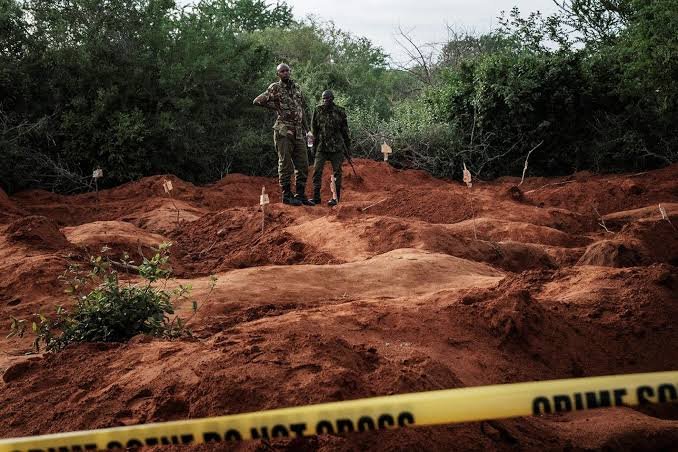
Three years after the discovery of mass graves in a forest outside Malindi sent shock through the country, the High Court is preparing to leave the courtroom and visit the very ground where prosecutors say hundreds of Kenyans lost their lives.
Judges presiding over the trial of Paul Mackenzie and seven co-accused will this week conduct a site inspection across three locations: Malindi town, Shakahola forest, and Kwa Bi Nzaro forest. The move marks one of the most significant steps in the proceedings so far, as the court seeks to anchor the evidence it has heard against the physical landscape where the alleged crimes are said to have taken place.
Mackenzie, the founder of Good News International Church, faces charges linked to the deaths of dozens of followers whom prosecutors say were convinced to starve themselves as an act of religious devotion. He and his co-accused, including Sharleen Temba Anindo, Kahindi Kazungu Garama, Tom Ochieng Mkonwe, Julius Thuva Luwali, and Johnson Gona Richard, have denied all charges. Two further suspects, Charles Mutua Musee and James Kazungu Kahindi, face separate allegations of helping others evade arrest. They too have denied wrongdoing.
The prosecution’s case rests heavily on witness accounts, photographs, and investigative records gathered in the aftermath of the deaths. Several survivors and bereaved family members have testified before the court, describing a system in which followers, including children, were moved from reception points in Malindi to remote forest camps. Once there, witnesses say, they were isolated from their families, encouraged to continue fasting regardless of their physical condition, and prevented from leaving.
The court’s inspection is intended to test whether those accounts hold up against the actual geography of the sites. Judges are expected to examine the temporary structures where followers were reportedly held, assess how adults and children were separated, and consider the distance and relationship between the Malindi transit points and the deeper forest locations.
A specific question before the court concerns whether Shakahola and Kwa Bi Nzaro formed part of a connected operation. More than 450 bodies were recovered from Shakahola after the site was discovered in 2023, triggering a national emergency and prompting extensive security operations. Kwa Bi Nzaro emerged as a separate but related site, where 52 further deaths were recorded, among them 23 children. Witnesses have told the court that some individuals who survived Shakahola later appeared at Kwa Bi Nzaro, a detail that prosecutors argue is central to understanding the alleged continuity of the operation.
The court will also review testimony about nighttime movements of followers from Malindi premises to forest locations, and will examine how the layout of those structures relates to what witnesses described inside them.
In Kenyan law, locus in quo visits, where a court physically inspects a scene relevant to the case, are permitted and occasionally ordered in serious criminal matters. They are particularly useful in cases where the spatial relationship between locations forms part of the prosecution’s argument, or where witnesses have described events tied to specific settings that written evidence alone cannot fully convey.
The decision to conduct such a visit in this case signals that the court is taking seriously both the complexity of the evidence and the scale of the alleged crimes. For families who lost relatives in the forests, and for Kenyans watching a prosecution that has taken years to reach its current stage, the week ahead carries weight that extends well beyond the legal proceedings.
The trial continues.